
🇩🇪 Diesen Beitrag auf Deutsch lesen
I have been to Singapore seven times – for me it feels like a second home. Most visitors know the skyline and the luxurious architecture in the city centre. But how do people actually live away from the tourist hotspots, out in the “heartlands” like Hougang? There, three very different kinds of high-rise buildings often stand right next to each other: simple, mid-range and luxury. I went to take a look and took photos.
Level 1 – Simple: The colourful HDB blocks
Most people in Singapore live in flats like these: around three quarters (about 76%) of residents live in flats built by the public housing authority HDB (Housing & Development Board). The blocks are often painted in bright colours and well maintained. On the ground floor there is usually an open hall (the “void deck”) where neighbours meet. Playgrounds, shops and cheap food stalls are close by.
What I have experienced myself: The fittings are often very basic. In the simple flats I know, there is no shower in the bathroom. Instead there is a water barrel with a small scoop – you use it to pour water over yourself. There is no fixed gas connection either; for cooking, a propane gas cylinder is connected. Not all HDB flats are like this: many newer flats are much more modern.
There is no pool, no gym and no security staff here. In return, living is comparatively affordable. Renting a 4-room HDB flat in Hougang cost a median of about S$3,200 per month in mid-2026 (approx. €2,200). Most families, however, do not rent – they buy their HDB flat.
Level 2 – The middle: Mid-range residential estates
One level up, things get much more comfortable. The flats have a proper bathroom with a shower and a fixed gas connection in the kitchen – no more gas cylinder. But there is no pool here either, and no security staff. It is solid, normal living: modern, practical and without luxury.
Level 3 – Luxury: The glass condos
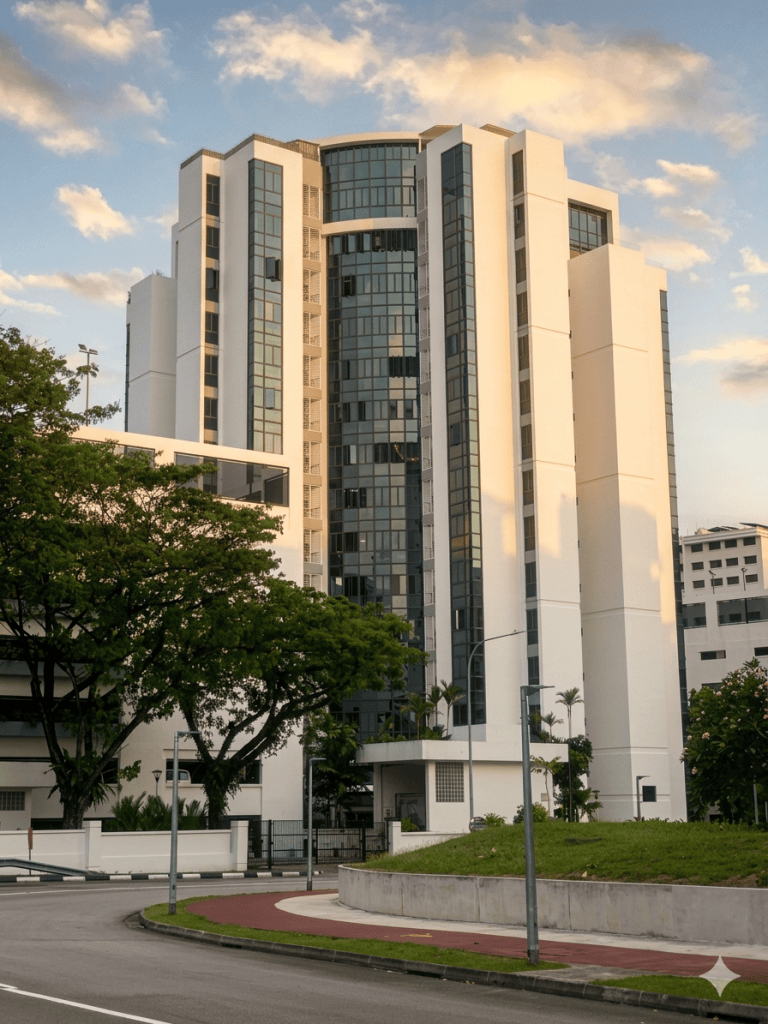
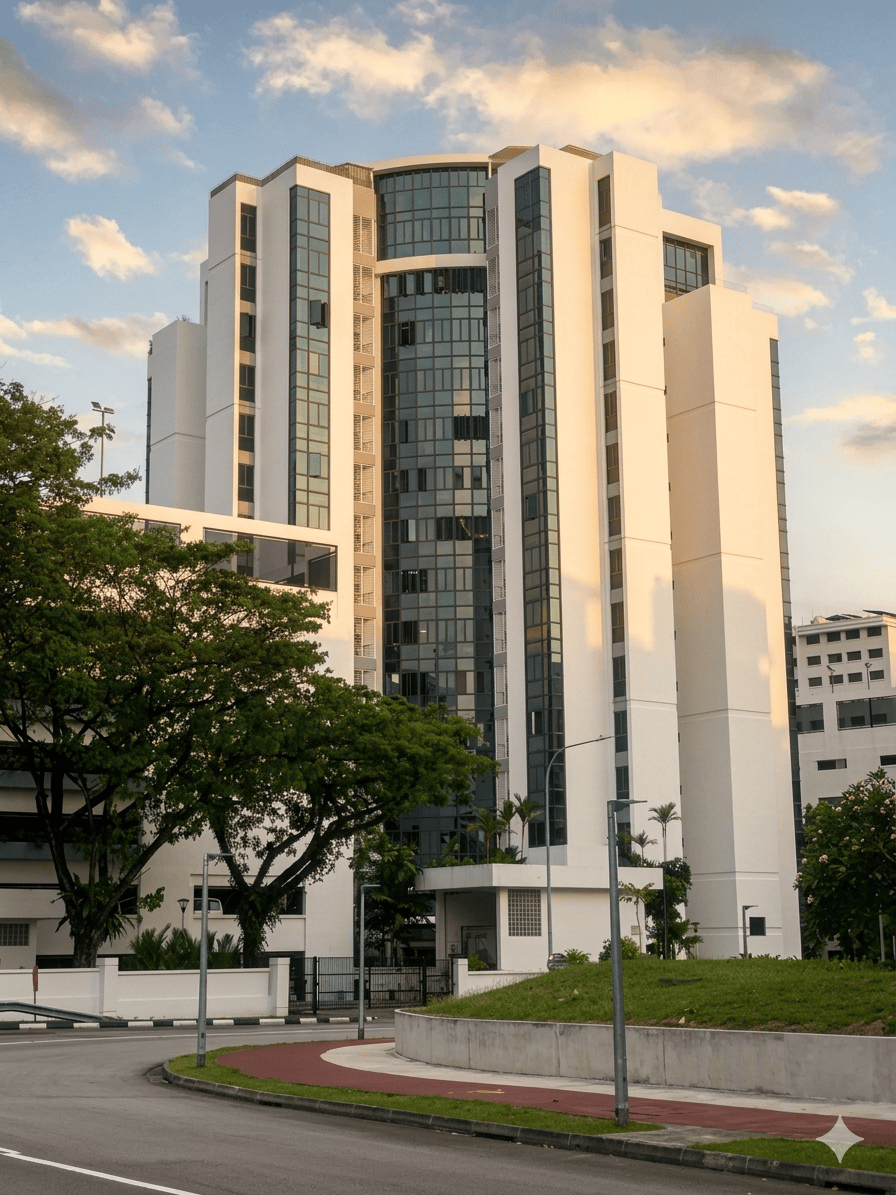
At the top are the private condominiums (condos for short) with their stylish glass facades that look like luxury hotels. Here everything is included – just like in a resort. When you rent a flat in Europe, you usually just get four walls. Here you get a complete lifestyle:
• Gated and guarded: The whole estate is surrounded by a wall. A security guard sits at the entrance and checks who wants to come in. No strangers can simply walk through the grounds – everything is closed off. You often need a key card for the gate and the lift. Sometimes the lift only goes to your own floor.
• Fully looked after: A caretaker takes care of everything in the building, and gardeners look after the green spaces.
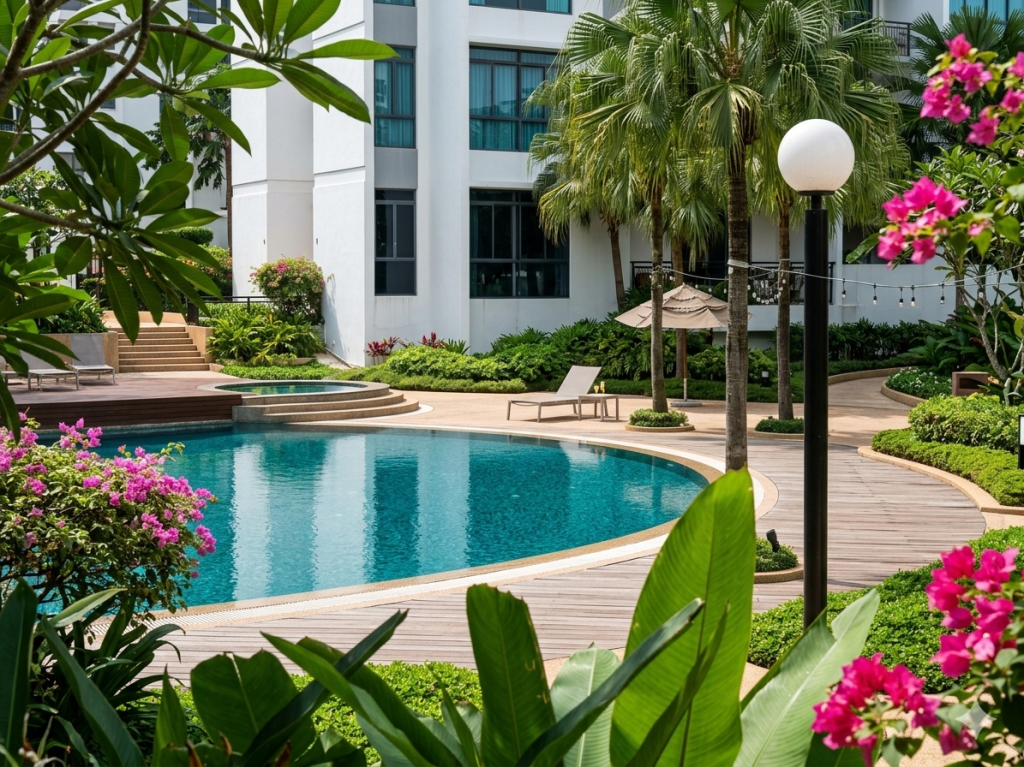
• Holiday at your doorstep: A pool is part of the package – in larger estates even a 50-metre pool, often also a children’s pool or a jacuzzi.
• Own gym and BBQ pits: Air-conditioned gyms, barbecue pits and function rooms can be booked for parties.
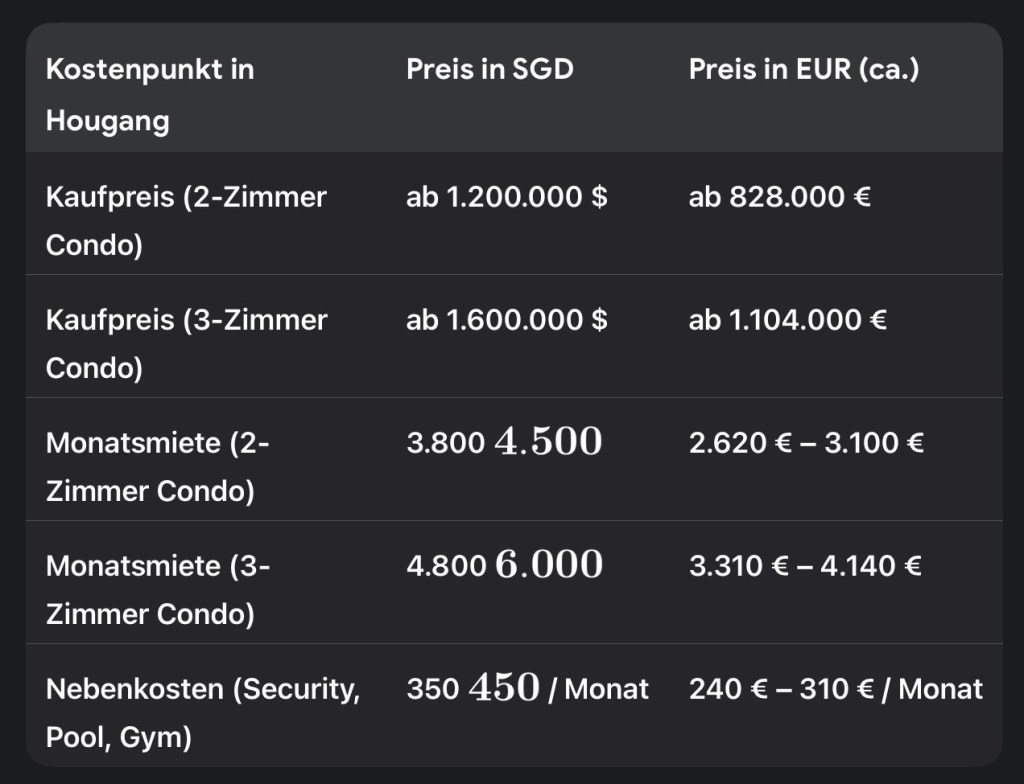
All of this has a price: owners pay monthly fees to the management (“maintenance fees”), outside the city centre usually around S$300 to S$700 (approx. €210 to €480). Tenants usually don’t pay this separately – it is included in the rent. According to listings, a small condo flat in Hougang starts at around S$2,600 per month. Larger flats in new estates cost considerably more.
My conclusion
In Hougang you can see within a few metres how differently people live in Singapore: simply, with a water barrel and a gas cylinder; solidly, with a shower and a gas connection – or luxuriously behind walls and glass with a pool, a guard and gardeners. What I find fascinating: all three stand side by side, and in the end all residents meet at the same food stall around the corner.
Sources (as of October 2026, conversion €1 ≈ S$1.45 according to the ECB):
• Share of HDB residents: HDB Key Statistics 2024/2025
• HDB rents in Hougang: MoneyBees (HDB data, June 2026)
• Maintenance fees: PropertyNet.sg
• Condo rents in Hougang (listings 2025): Rentify.sg
• Exchange rate: European Central Bank
Descriptions of the fittings: my own observations. Prices change all the time. All information without guarantee. All photos: Mario Lee.


Hinterlasse einen Kommentar