🇩🇪 Diesen Beitrag auf Deutsch lesen
Imagine you move to the other side of the world, and suddenly nothing works the way you know it. In Germany, my communication as a deaf person was clearly divided and well practised. With my family I communicated only in spoken language – there was never any signing. With my colleagues, too, spoken language was the main tool, with just a little sign language. Only with my deaf friends and acquaintances did I switch completely to my mother tongue, sign language.
But I have known Singapore for 11 years now, and my everyday life there is a fascinating, but often complicated puzzle made of four completely different worlds.
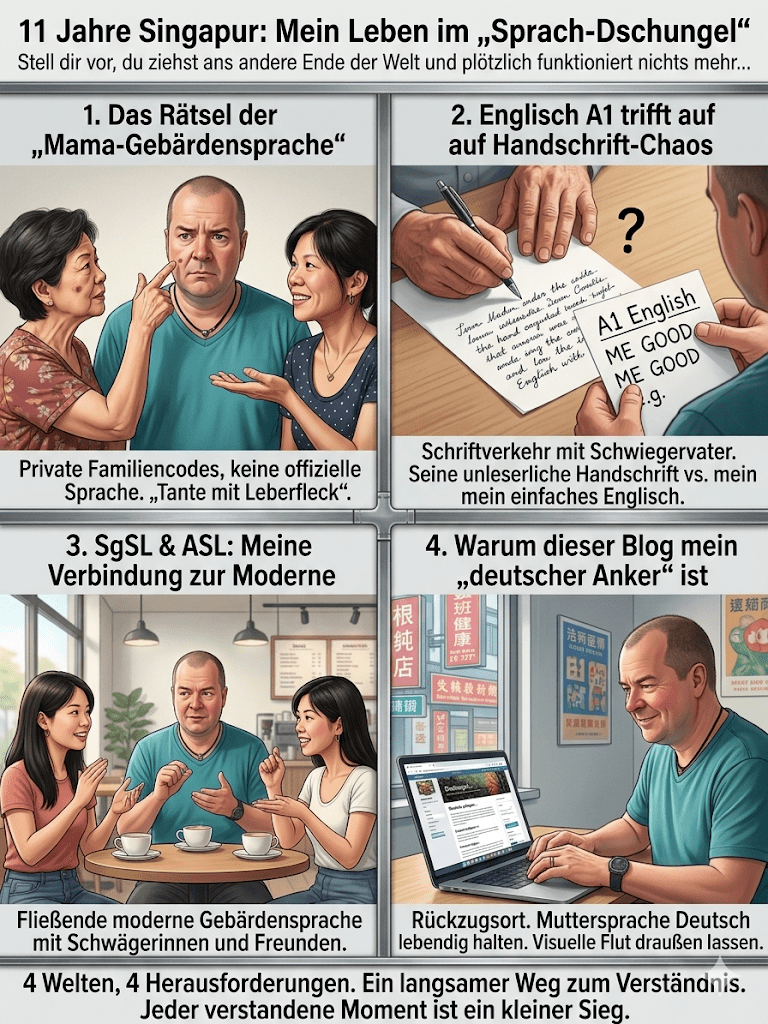
1. The mystery of „Mama sign language“
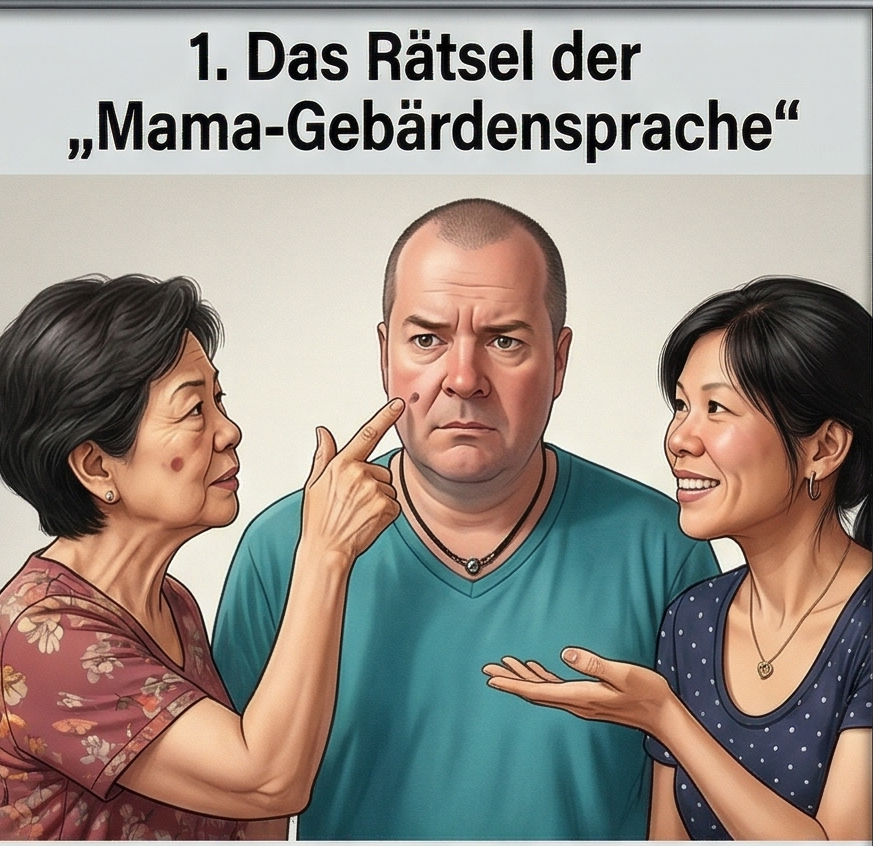
The heart of my wife’s family is my mother-in-law. But if you think we use an official sign language, you are wrong. She communicates in a very private „Mama sign language“.
These are not signs you learn at school, but a family code that has grown over decades. People are named after very specific features – for example „the aunt with the mole“. There are special signs for the first or the third aunt, and very particular symbols for „Come and eat“. Because I didn’t grow up with these private signs, my wife is often my most important interpreter. We crack these codes a little more every day.
2. A1 English meets handwriting chaos
With my father-in-law, almost everything happens in writing – in English. That sounds easy at first, but it isn’t. My written English is at about A1 level, and his handwriting is so complicated that I can hardly read it. We understand each other at the core, but for deeper conversations we often need my wife as a bridge here, too.
3. SgSL and ASL: my connection to the modern world
It is completely different with my two sisters-in-law. They learned the official Singapore Sign Language (SgSL) in Singapore. Because it is very closely related to American Sign Language (ASL), and I know ASL well, communicating with them works almost smoothly.
With my deaf friends in Singapore and Malaysia, too, I use a mix of ASL and SgSL. It gets really exciting with the older generation – they often still use very old Chinese signs, which again have their very own visual patterns.
4. Why this blog is my „German anchor“
Whether at home or on TV: Chinese and English are flickering all around me. It is a constant visual flood. That is why this blog is my place of retreat. Here I write in German, not only to keep my mother tongue, but to keep it alive.
Despite all the hurdles, I stay calm and friendly. I notice how, day by day, I understand more of these private „Mama signs“. It is a slow path, but every moment of understanding is a small victory over the language barriers.


Hinterlasse einen Kommentar